Wednesday, 28 February 2007

Tuesday, 27 February 2007

And the Oscar for navel-gazing goes to... | Dt Opinion | Opinion | Telegraph

Surely it is time that this 'ceremony' was realised to be a somewhat pointless anachronism, and duly canned? Come on, it's not even lightweight entertainment/glamour, is it? If so, to whom?

Well done to Helen Mirren for at least bringing a bit of grace and humility to proceedings (in an excellent film, by the way), but this is beginning to look an increasingly tasteless, disingenuous and utterly irrelevant 'event'. In this era of perspective, humility, accountability and transparency this is the last bastion of crassness and hubris.

--


I stayed up all night to watch the Oscars, then immediately wished I had spent those precious hours making Easter cards with the mentally ill. The whole thing was hyped in advance as a British invasion - lock up your Oscars, the ultra-talented Brits are coming to sweep the town! In the end, we won two, while a conga-line of statuettes was last seen making its way from the Kodak Theatre to the upper reaches of Beverly Hills.

Why do we buy into this nonsense every year? Is it because each nation nowadays experiences a cultural cringe when faced with the great power of the American entertainment industry? Hollywood recognition, it would appear, not only trounces any other kind of plaudit, but fills actors, directors and like-minded individuals with the feeling that only through the Oscars can they address the world.

This might be good news for the American Academy of Motion Picture Arts and Sciences, but it's not good news for America. The Oscars, more perhaps than any other US institution, is a powerhouse of strictly American feelings, and the world as a whole is not always crazy to have that kind of feeling stuffed down its throat. Hollywood is a very small community of wealthy and successful people, devoted to the high-gloss business of congratulating itself. And despite its gestures towards "respecting" and "recognising" foreign excellence, the Academy Awards ceremony only knows how to celebrate foreignness in purely American terms. That's to say - patronisingly.

More than 80 per cent of Americans do not own a passport. Hardly any young people speak a second language. Though a majority of the population are said to favour military intervention in the Middle East, fewer than one in 50 can name the countries that border Iraq. (This might explain why the British movie Borat, which satirises this situation, won nothing at the Oscars.)

Further to that, the criminalisation of economic migrants in the US is rife, but was nowhere mentioned in the six hours of Oscar telecast, despite one of the main nominated films, Babel, dealing with the subject.

The difficulty is that Hollywood sees itself as a community of sophisticated kingmakers. It was more embarrassing than funny to see leading actor Leonardo DiCaprio, during the ceremony, trying to convince former vice president and 2000 presidential nominee Al Gore to announce his plans to run in 2008. The Academy was celebrating Gore's hard-hitting and enjoyable global warming film, The Inconvenient Truth (it won Best Documentary), but none of these so-called politicos was willing to use the Oscars to criticise American policy in that area. No - it was joy, joy, fun, fun, all the way, and everybody got to look like a grinning idiot about those matters that really matter.

Meanwhile, just before they unrolled the red carpet for the 79th Oscars, the co-chairman of DreamWorks, David Geffen - who is also a leading organiser in this week's Hollywood fundraiser for presidential candidate Barack Obama - unleashed a powerful public onslaught on Hillary Clinton. "Everybody in politics lies," said Geffen, "but they [the Clintons] do it with such ease, it's troubling." Geffen was a serial guest at the White House during the Clinton Administration - after raising $19 million for Bill's campaign - but has gone sour on the Arkansas couple since Hillary refused to renounce the Iraq war.

Was there a sign of any of this disputation at the Oscars? Not a bit of it. Amid the backslapping and the "celebration" of foreign cultures, there wasn't a single word about how America's standing in the world may have been damaged by recent events and by the country's failure to face the facts about its ailing reputation abroad.

Into this farrago of glitzy evasion came the British nominees, Helen Mirren picking up a Union flag from a television reporter and waving it for the world's cameras, as if to beg for some small, green and pleasant recognition in the midst of this great heatwave of American arrogance. And it seems the whole civilised world is a sucker for that heat, including those Americans who have spent their careers railing against complacency and falsity in national affairs.

Martin Scorsese wanted his Oscar so bad, he looked like he might murder somebody if he didn't get it. And when he did, what an obsequious, fawning performance he gave: no culture has a people so ready to invoke the name of God as soon as they get exactly what they want. After countless nominations, Scorsese received his award from a triumvirate of 1970s so-called mavericks - Francis Ford Coppola, Steven Spielberg, George Lucas - and looked like he might faint with gratitude that the Establishment had finally given him the nod. It might have been more stylish if he had thrown it back in their faces.

"Hollywood is a place where they'll pay you a thousand dollars for a kiss and 50 cents for your soul," said Marilyn Monroe. I've always loved the movies, but hated the way the American industry lords it over the globe, practising prejudices and enforcing stereotypes while claiming to be the last bastion of liberal progress.

This year's ceremony featured a self-congratulatory montage of movies that were thought to have dealt in a decisive way with difficult human issues; but it was all nostalgia and showbusiness, the hallmark of the Academy Awards.

No one wanted to use the platform to grapple with the difficult topics of our day, unless they could prove immediately "inspiring". The 2007 Oscars might have been the most expensive exercise in not rocking the boat ever mounted.

The advertised British invasion was a piece of nonsense, of course, and the best of the international talent left the auditorium empty-headed, if not empty-handed, after their spell under the klieg lights and the falling tinsel.

Perhaps next year's British contenders will prove less deferentially inclined to believe the Hollywood hype, and will bring a more characterful dose of scepticism to the proceedings.


And the Oscar for navel-gazing goes to... Dt Opinion Opinion Telegraph

Monday, 26 February 2007

GigaOM » Hollywood Disrupted

Reading through the LA Times, as I do before The Oscars every year, I came across a fantastic Op-Ed written by a respected Hollywood author by the name of Neal Gabler. The opinion piece, titled “The Movie Magic is Gone”, explains how Hollywood is losing its place as the epicenter of cultural products and how movies are losing their relevance as the “barometers of the American psyche”.
And what is culprit? You guessed it… the rise of social media! As Gabler elaborates:

“All of this has been hastened by the fact that there is now an instrument to take advantage of the social stratifications. To the extent that the Internet is a niche machine, dividing its users into tiny, self-defined categories, it is providing a challenge to the movies that not even television did, because the Internet addresses a change in consciousness while television simply addressed a change in delivery of content. Television never questioned the very nature of conventional entertainment. The Internet, on the other hand, not only creates niche communities — of young people, beer aficionados, news junkies, Britney Spears fanatics — that seem to obviate the need for the larger community, it plays to another powerful force in modern America and one that also undermines the movies: narcissism. It is certainly no secret that so much of modern media is dedicated to empowering audiences that no longer want to be passive. Already, video games generate more income than movies by centralizing the user and turning him into the protagonist. Popular websites such as Facebook, MySpace and YouTube, in which the user is effectively made into a star and in which content is democratized, get far more hits than movies get audiences. ”

What Gabler calls “narcissism,” I prefer to use the term “digital self expression”. And as I wrote almost a year ago in a piece titled “Social Networks are the New Media”…

“To some extent, self-expression should be viewed as a new industry, one that will co-exist alongside other traditional media industries like movies, TV, radio, newspapers and magazines. But in this new industry, the raw materials for the “products” are the people… or as Marshall McLuhan might say, “the people are the message” when it comes to social networks.

So for any player who seeks to enter this industry and become the next social networking phenom, the key is to look at self-expression and social networks as a new medium and to view the audience itself as a new generation of “cultural products”. In the past century, the creation of cultural products was centered in Hollywood. Now, social networks are broadening the scope of cultural media to include “identity production” (a very appropriate term coined by danah boyd), all the while decentralizing the ecosystem out to the edges.

For traditional media companies that are seeking to enter this space (e.g. MTV, Martha Stewart, etc.), it’s critical to follow the audience into the development of this new market by re-focusing core assets that have the capability to deepen the level, and heighten the production value, of self-expression. ”

What Gabler and I both seem to be focusing on is the very real possibility that what is truly disrupting Hollywood is not technology per se, but what the technology is enabling the audience to do and how it’s affecting the public’s “consciousness”. In other words, the future of Hollywood may not ultimately rest on issues like how well the studios transition their business models to adapt to digital distribution schemes or how they handle massive copyright infringement.

Instead, what Hollywood might look like in the year 2020 could have more to do with how studios develop new “products”… much like they did with the advent of television (when they created sitcoms, game shows, movies of the week, etc.). But this time, future Hollywood products will probably have to integrate and leverage the virtually unlimited digital resource of self-expression and social media.
At the end of the day, what we’re talking about is the emergence of a new medium with its own art form. And whether Hollywood will remain at the epicenter of future cultural production is the big question. For the first time, Hollywood should be concerned like never before simply by virtue of the fact that, this time, the means of production are now in the hands of the audience itself. What this implies, at the very least, is that the studios will have to increasingly democratize their business model. What does that mean exactly? Go ask the CEO of Veoh.


GigaOM » Hollywood Disrupted

Thursday, 22 February 2007

How Hitler gained power. - By Clive James - Slate Magazine


The following essay is adapted from Clive James' Cultural Amnesia, a re-examination of intellectuals, artists, and thinkers who helped shape the 20th century. Over the coming weeks, Slate will run an exclusive selection of these essays, going roughly from A to Z, abbreviated for these pages.


You have everything that I lack. You are forging the spiritual tools for the renewal of Germany. I am nothing but a drum and a master of ceremonies. Let's cooperate!—Adolf Hitler at the ­Juni-­Klub, spring 1922, as quoted in Jean Pierre Faye's Langages totalitaires.

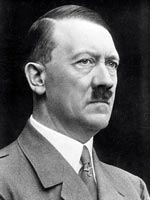
Adolf HitlerAdolf Hitler (1889–1945) should need no introduction. Statistics suggest, however, that a large proportion of young people now emerging from the educational systems of the Western democracies either don't know who he was or have only a shaky idea of what he did. One of the drawbacks of liberal democracy is thus revealed: Included among its freedoms is the freedom to forget what once threatened its existence. Granted the uncontested opportunity to do so, Hitler would have devoted himself to eliminating every trace of free expression that came within his reach. The awkward question remains of whether, on his part, this propensity precluded any real interest in the humanities. The awkward answer must be that it didn't.


Though it is tempting to think of him as illiterate, Hitler could quote Schopenhauer from memory. His love of music was passionate, to the point where some believed that his admiration for Wagner was a sufficient reason in itself for dismissing that composer from musical history. Hitler the would-be painter never lost interest in the plastic arts. His projected art gallery in his home town of Linz was one of his most dearly cherished dreams for Nazi Europe after the inevitable victory. Above all, Hitler was moved by architecture, which brings us to the central point, because he wasn't just moved by it, he was mad about it. He had no sense of proportion in any of his ostensibly civilized enthusiasms. His interests lacked the human element, so they could never have amounted to a true humanism. But though his connection with the civilized traditions was parodic at best and neurotic always, there was still a connection: In that respect, he stands above Stalin and Mao and should therefore, by the scholar, be handled with even greater caution, because he is far more poisonous.


Many of his more cultivated victims used their learned resources to deny that Hitler had a mental existence. Some of the last aphorisms written by the great Robert Musil were devoted to summarizing the pathogenic nature of Hitler. Beautifully crafted statements, they had no effect on Hitler whatsoever. The finest minds in Europe devoted their best efforts to proving that their mortal enemy had no mind at all. But nothing they said was of any avail. Hitler could be defeated only by armed might: i.e., on his own terms. Whole libraries written to his detriment didn't add up to the effect of a single Russian artillery shell. This ugly fact should be kept in view when we catch ourselves nursing the comforting illusion that there is a natural order to which politics would revert if all contests of belief could be eliminated. There is such a natural order, but it is not benevolent.


Books about Hitler are without number, but after more than 60 years, the first one to read is still Alan Bullock's Hitler: A Study in Tyranny. Familiarity with the events that it recounts should be regarded as an essential prerequisite to the study not just of modern politics but of the whole history of the arts, since its hideously gifted subject first demonstrated that a sufficient concentration of violence could neutralize any amount of culture no matter how widely diffused. It is not possible to be serious about the humanities unless it is admitted that the pacifism widely favored among educated people before World War II very nearly handed a single man, himself something other than a simple Philistine, the means to bring civilization to an end.


Respectably situated in Berlin's Motzstrasse, to the south of the Tiergarten, the Juni-­Klub, or June Club (the name breathed defiance at the Treaty of Versailles), was a '20s talking shop for ­right-­wing intellectuals concerned with revolutionary conservatism. The consciously oxymoronic idea of revolutionary conservatism had almost as many forms as it had advocates, who found it easy to mistake their dialectical hubbub for the clanging forge of a new order. Of the 150 members, 30 were present on the afternoon Hitler dropped in. They thought he had come to hear what they had to say, and they found out that he had no intention of listening to any voice but his own. Their scholarly qualifications counted for nothing. Best qualified of all was Arthur Moeller van den Bruck. Before World War I, Moeller had been a translator of Baudelaire, Defoe, De Quincey, and the complete poetry of Edgar Allan Poe, and had written essays on Nietzsche, Strindberg, and others. He knew Paris well and spent time also in London, Sicily, Venice, the Baltic countries, and Russia. For cultivation he was up there with Ernst Jünger, one of Germany's most gifted modern prose writers and likewise a revolutionary conservative.

PAGE: 12NEXT »


How Hitler gained power. - By Clive James - Slate Magazine

Monday, 19 February 2007

I've signed up to the wonder of e-petitions | Dt Opinion | Opinion | Telegraph

A Digital Democracy ....? Digital Dementia, more like.

--

I am in thrall to a new internet obsession. Since I found it, YouTube, which used to dominate much of my so-called working day, no longer holds sway (well, there are only so many videos of Britney Spears shaving her head that one can take).

Sneezing pandas, plummeting sky-divers, Tony Blair proclaiming to George Bush his "Endless Love": none of the highlights of the online orbit can detain me any longer. Not now that I have embraced the world of the e-petition.

The Government's e-petitioning website has only been in operation since November, but already there is nowhere that holds a better mirror up to the national psyche. In 50 years' time, all historians need do to find out precisely what kind of Britain their forebears inhabited is study the weekly top 10 e-petitions.
advertisement

What more could they learn of our society, for instance, than that 3,626 people have signed up to demand that the Prime Minister stand on his head and juggle ice cream?

Another 3,868 citizens felt moved enough to insist that our elected representatives "replace the national anthem with Gold by Spandau Ballet". And those are the ones that made it to the approved list. Not that the historian should ignore those that get rejected.

Some, such as the several dozen which request that the Prime Minister "resign", "resign now" or "resign forthwith", are disallowed for plain rudeness.

Others, though, are turned down because they plead for legislation rather more specific than general. Such as the one which asked the PM to "end the rules of male primogeniture with regard to succession to the Earldom of Stirling via a Resettlement-by-Letters Patent to the current Lord Stirling". And the name of the person who submitted it? The Earl of Stirling.

Of course, there are petitions up there of rather more pertinence to those outside the earl's immediate family. The one that aims to keep the British Library free of charge, with no budget cuts, is something every civilised citizen should sign.

As is the one that insists the PM "recognise that music and dance should not be restricted by burdensome licensing regulations". I have also added my name to the demand that the Government "provide a reliable train service with adequate capacity at times that travellers wish to make journeys from Swindon to Westbury, Bristol to Severn Beach...".

Not of much immediate geographical relevance to many users of the site, I admit, but its intentions are commended.

Dominating the site right now, however, sitting there like a juggernaut stuck in the Hanger Lane gyratory system, is the petition that asks the Government to shelve its plans for road pricing. At the time of writing, 1,578,405 people had added their names. If you want to join them, you will have to hurry: the petition closes tomorrow.

Even before it does, the Prime Minister has welcomed it as "an opportunity... to have a full debate". He has promised that he will give his answer to it forthwith. If it is anything like those already posted on the site, this will say something like: "Thanks for your petition, which we very much appreciate. However, you are wrong and we will be pressing ahead with our policy, no matter how many people actively publicise their opposition." The petition will then be quietly removed from the list.

And maybe that's the most valuable lesson for us e-petitioning obsessives: we may have the technological wherewithal, but that doesn't mean anyone will pay us any heed.

The e-petition is designed to give the impression of openness and accountability - it "shows that my government is listening" says Mr Blair. But it is entirely illusionary - no more legislative common sense will come out of the site than from those shoeboxes filled with signatures clogging up the bowels of No 10.
Not that a mere detail like total powerlessness is going to stop the determined e-petitioner. After all, where else can a concerned citizen demand that the PM stick his head in a bucket of custard and gargle the national anthem? Just signing feels like therapy.


I've signed up to the wonder of e-petitions Dt Opinion Opinion Telegraph

Sunday, 18 February 2007

News - Arctic Monkeys

The Arctic Monkeys are undertaking a series of short-notice/no pre-show-publicity small-venue gigs lately (we just missed their hometown - ie, Sheffield, if you didn't already know - gig at the great Leadmill venue, drat - especially 'drat' as we're only 20miles from Sheffield) - this being the classically difficult sophomore album it's good to hear that those who have seen them preview their new material (below) at recent gigs are saying it sounds excellent - a bit heavier than the 1st album, but that's no bad thing.


Very much looking forward to seeing them live this summer - I may be one of the oldest in the audience but what the hell!

Along with the much more obscure (at present) 'The Hair' the Arctic Monkeys really re-kindled my love of contemporary music. Just hope they get around to doing a gig at our mutually favourite football team's ground, Sheffield Wednesday @ Hillsborough.

The place needs some good karma after years of decline on and off the pitch; massive debts, an absurd turnover of managers (10 in 10 years), let alone the haunting memories of the tragic deaths of 96 Liverpool fans (which seems just like yesterday).
We shouldn't forget the tragedy of that day and the incompetence that lead to the needless deaths of so many, but I do believe our ground needs a cathartic cleansing to redress the balance/karma. Anyway, I digress ...


One day, maybe - when we're in the Premiership? If so, I won't hold my breath ...

--


Arctic Monkeys are pleased to announce that their new album entitled ‘Favourite Worst Nightmare’, will be released on Monday 23rd April.

The track listing will be:
01. Brianstorm
02. Teddy Picker
03. D is for Dangerous
04. Balaclava
05. Fluorescent Adolescent
06. Only Ones Who Know
07. Do Me a Favour
08. This House Is a Circus
09. If You Were There, Beware
10. The Bad Thing
11. Old Yellow Bricks
12. 505

The first single, 'Brianstorm' will be released on Monday 16th April.


News - Arctic Monkeys

BBC Radio 4 - Factual - Desert Island Discs -Grayson Perry

This week's guest is on as I type - the one that prompted me to gush so much in an earlier entry re: Desert Island Discs ... if and when I have a ridiculously large amount of surplus money I shall be in the queue for one of his works.
He's even a fan of The Fall and a 'biker. What more is necessary?

--

Kirsty Young's castaway this week is the artist Grayson Perry. For more than 20 years his work was broadly unknown outside the narrow confines of the art world.

But in 2003 he became a household name after a collection of his exquisitely ornate pots won him art's most prestigious award, the Turner Prize.

He's described as 'the hottest potter in the world' but newspaper headlines describing his success focused at least as much on his clothes as his art - when he collected the prize he wore a lilac party dress with a bow in his hair.He started dressing in his sister's clothes when he was a child - initially as part of his imaginative games and then for an erotic thrill.

In part, women's clothes represented the tender emotions he was too scared to show in his repressive and sometimes frightening family home. Now, they're a way of controlling how people see him, what kind of attention he attracts and, if nothing else, they're a unique selling point. He acknowledges the debt he owes to his profession; only the arts would tolerate, he says, a transvestite potter from Essex.

His choices include:

Record: Prophecies (Philip Glass)
Book: An art book on Gothic and Renaissance Altar pieces
Luxury: Loads of really good pens and paper

BBC Radio 4 - Factual - Desert Island Discs -Grayson Perry